
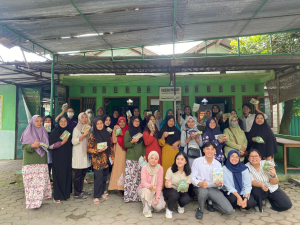
 On Saturday, March 15th, 2025, undergraduate Nutrition students of Gadjah Mada University, as part of Group 7 of the Nutrition Program Implementation course, conducted an educational activity for the residents of Dukuh Nogosaren. This event titled Pawon Resik: Ora Sisa, Ora Boros, served as the opening session to a series of activities aimed at raising the public awareness about the importance of responsible and sustainable food consumption. The activity took place at the residence of Mr. Solikhin Nur Cahyo, S.Ag, and was attended primarily by housewives from RT 05, 06 and 07.
The session began with a pre-test containing questions designed to assess the initial knowledge of the participants on the topics to be covered. The education consists of 3 main topics: Food Loss and Food Waste (FLFW), meal planning, and meal preparation. In the first session, the participants learned about the definition of FLFW, its negative impacts, common causes, and potential solutions. The second session covered the concept of meal planning, including its definition, benefits, step-by-step guide of meal planning and tips for shopping wisely. The final session focused on meal preparation, explaining its purpose, principles of food storage, ideal refrigerator organization, and proper food storage techniques. The activity concluded with an interactive Q&A session, where participants actively asked questions and shared their own experiences. A post-test was then conducted to evaluate the participants’ knowledge improvement. In addition, all participants received an educational module for further readings. The module included the Pawon Resik Journal and Composting Journal, which serve as practical tools to help them implement what they learned. The results documented in these journals will contribute to determining the winner of a final prize at the end of the activity series.


Overall, the event was successfully conducted and warmly welcomed by the participants. They showed great enthusiasm, not only by asking insightful questions but also by sharing their personal practices. Through this activity, it is hoped that the housewives of RT 05, 06 and 07 in Nogosaren will be better equipped to manage their household food more wisely and efficiently, reducing food waste in the process. This activity also supports the 12th Sustainable Development Goal (SDG): Responsible Consumption and Production, specifically through efforts to reduce food waste by promoting efficient and sustainable food management practices at household level.
Contributor: Marius Hartanto, Permata Dinda Diavisya, Wanda Azka Atsiila
SDGs: 2. Zero Hunger; 3. Good Health and Well being; 12. Responsible Consumption and Production